OtterX
Personal project. AI-driven Solana trading terminal featuring buy signals, wallet tracking, Jupiter autotrading via base64 integration, and a journaling layer for web3 traders. Rapidly iterated with Figma + Claude; deployed to Vercel (frontend) and Vultr (backend).
Origins · 2024
Meet Kotaro — the otter that was a master of trading 🦦
The original concept wasn't a terminal at all. It was Kotaro — a character I'd written as an otter who was a master of trading. The idea was simple: instead of me managing positions, Kotaro would. The first surface I gave him was a Telegram bot, scaffolded with Botfather, that I could ping like a friend who happened to know the Solana market cold.
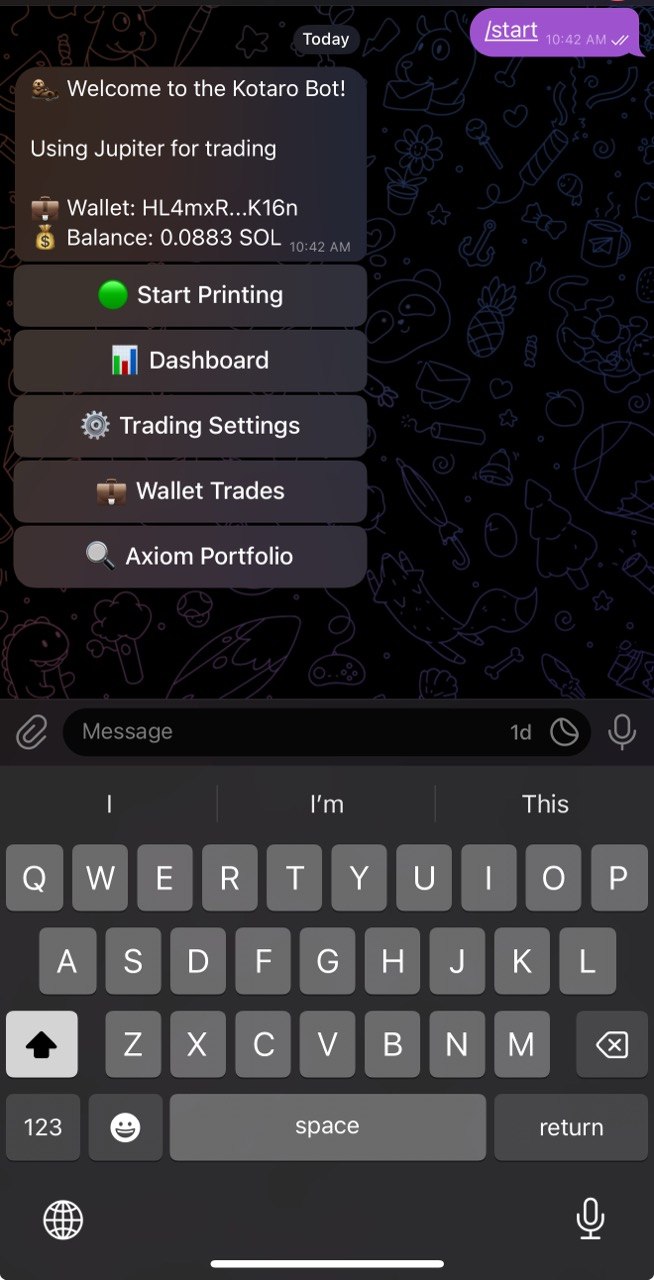
Type /start and Kotaro greeted you with your wallet, SOL balance, and a row of menu buttons — Start Printing, Dashboard, Trading Settings, Wallet Trades, Axiom Portfolio. Trades routed through Jupiter under the hood. Scrappy, but it solved the immediate problem: react fast without leaving the surface I was already in all day.
At the center of OtterX is Kotaro's autotrade engine. The thesis is blunt: a disciplined machine that never blinks will out-execute a human who has to sleep, eat, and feel things. Kotaro runs one continuous loop — listen, qualify, enter, exit — and the whole cycle closes in seconds. You set the bank, set the gates, and walk away.
Under the hood
The four-stage loop
Every stage is a hard checkpoint. Signals that survive ingestion still have to clear a strict gate before a single lamport moves, and once a position is open it lives or dies on a tiny, deterministic rule set. No vibes, no "let it ride."
Listen
Two scanners stream every fresh pump.fun launch in real time, while a wallet tracker watches a curated list of smart-money wallets for clustered buys landing on the same mint. Conviction shows up as a crowd, not a single trade.
Qualify
Every signal runs a five-gate filter before it counts as an entry — any single failure drops it on the spot. The gates exist to reject late entries, low-conviction tokens, and bundle/rug templates that are designed to look exactly like the real thing.
Enter
A qualified signal buys at 30% of session bank and routes through PumpPortal. The wallet is snapshotted before the buy, so Kotaro can only ever manage tokens it opened itself — it never reaches into manual positions.
Exit
Once open, the position ticks every 0.75 seconds against four exit rules — first one to hit closes the trade, usually inside five seconds. A buy-pressure check defers stops while the tape is still accumulating, so a winner isn't cut off at the knees on a wick.
After the sell, Kotaro reconciles the real SOL recovered from a post-trade wallet diff — actual on-chain delta, not an optimistic estimate — then discards the position. It doesn't adopt manual buys, doesn't re-enter mints it just exited, and never sells tokens it didn't open. Clean boundaries, every cycle.
TL;DR — whale clusters on fresh tokens with a public X handle → buy 30% of bank → exit fast on a tight rule set → repeat.
Exit-evaluation cadence
Why it ticks this fast
Sub-five-second holds, by design
On-chain Solana moves on a clock that punishes hesitation. Strong setups can run 5–10x and round-trip back to zero inside a single afternoon. A position that re-checks its exits four times every three seconds isn't paranoia — it's the only honest way to hold an asset this volatile. Most trades open and close before a human would finish reading the chart.
The problem it answers
The opportunity is real. The cost of being human is brutal.
These markets reward full-time attention — the screens, the reaction speed, the stomach to sit on a feed all day. Most people have none of that to spare, so they either miss the moves entirely or get chopped up trying to chase them. OtterX is built for the people who want exposure to these setups without daytrading them.
Manual mode
Swing-trade strong setups yourself — clean charts, watchlists, signal feeds, and journaling, all on one surface built for fast, deliberate decisions.
Autotrade mode
Hand the wheel to Kotaro entirely. Set the bank, set the gates, walk away. The engine listens, qualifies, enters, and exits without you in the loop.
Hard boundaries
Manual and auto never collide. Kotaro only touches positions it opened, reconciles real recovered SOL per trade, and never re-enters a mint it just left.
Nine months in
The engine worked. The chat surface was the ceiling.
I ran that bot for nine months, layering on signals, wallet tracking, and Jupiter routing until the trading logic was genuinely sharp. The bottleneck was never the strategy — it was the interface. Watchlists, charts, and journaling all wanted a real product surface, and Telegram primitives could only do so much before everything became a thread of slash commands.
The shift · 2025
Claude Opus changed the slope
Once I started building with Claude — and especially Claude Opus — the work compounded in days instead of months. Surfaces I'd been sketching forever (the full trading terminal, the wallet timeline, the journaling layer) shipped in a matter of days. Pairing Figma with Claude Opus collapsed the gap between what I could imagine and what I could ship, and OtterX went from a scrappy bot to a real product surface wrapped around the engine that already worked.
Stack
Built with Figma + Claude Opus
Today OtterX runs on Next.js with Solana + Jupiter integrations, deployed across Vercel (frontend) and Vultr (backend). Designed in Figma, built end-to-end with Claude Opus as a coding partner.
Disclaimer. OtterX is in active testing and is not yet a finished, audited product. Nothing on this page or inside the app is financial advice — on-chain markets are volatile and you can lose your entire bank in a single trade. Use at your own risk, and only with capital you can afford to lose.